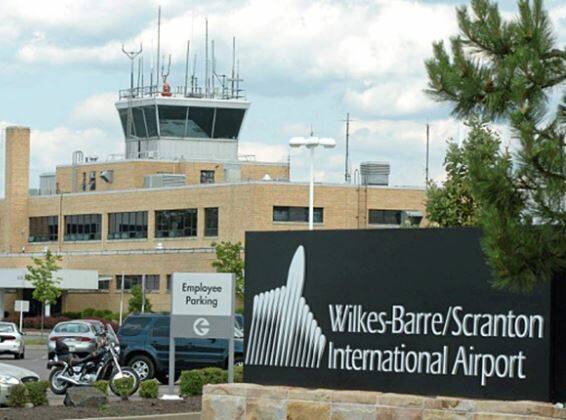
The Wilkes-Barre/Scranton International Airport in Pittston Township.
Times Leader file photo
After months of back-and-forth, Luzerne County has reached an agreement with Lackawanna County to continue jointly operating the Wilkes-Barre/Scranton International Airport in Pittston Township, officials said.
“Finally, we got Lackawanna County and Luzerne County to be able to agree, which is wonderful because now we can apply for our grants that the airport needs to survive,” Luzerne County Councilwoman LeeAnn McDermott, who chairs the Bi-County Airport Board, said at last week’s council work session.
The Federal Aviation Administration had informed the airport that future airport grant funds are at risk if a bi-county agreement is not executed, officials said in October. Approximately $21.3 million in federal grant funds are anticipated for airport projects over the next few years.
The 2.5-page cooperation agreement between the counties dates back to 1968.
However, the FAA determined a single airport sponsoring entity is needed for federal grant recipients.
“It was not being operated illegally, but it wasn’t meeting all the standards,” Luzerne County Chief Solicitor Harry W. Skene said of the arrangement.
An official partnership was pursued due to a lack of support for the two other options available for federal compliance — formation of an airport authority or designating one of the two counties as the airport sponsor, Skene said.
McDermott said solicitors from both counties “worked very hard” on the agreement. The plan is for each county to vote on the partnership agreement before the end of January so federal grants are not impacted, she said.
Partnership details
Called the “AVP Bi-County Partnership,” the alliance must be registered with the Department of State’s Corporation Bureau.
According to the proposed partnership document:
Each county will be equally responsible for the costs associated with operating the airport.
If airport revenues are insufficient to cover operating costs, each county must equally contribute funds “until the deficiency is reasonably resolved.”
In a situation where one county is unable to contribute in whole or part, the other county must supplement the costs on the condition the non-contributing county enters into a formal agreement to repay that amount to the other county on terms amenable to both, it said.
Both counties will “share equal responsibility” for hiring and employing law enforcement officers stationed at the airport during operating hours.
All airport property will be held in the partnership’s name.
The property will be surveyed to create two separate deeds grouping airport property by county.
Worst-case scenario
Through the agreement, both counties acknowledge they have an obligation to operate the airport as a condition for receiving federal financial assistance.
Any airport closure would be subject to FAA approval and must comply with federal law, including the potential repayment of federal assistance, it said.
If closure occurs, the partnership would have to transfer airport real estate to the county in which it is located.
Separately from the land, a process was established to ensure both counties have an equal stake in the value of all structures, known as “permanent improvements.” Permanent improvements include any airport fixtures, facilities, buildings, and pavement.
Under this clause, Luzerne County would have to pay Lackawanna 50% of the appraised fair market value of improvements situated in Luzerne County, and Lackawanna would be subject to the same procedure for airport infrastructure falling in its county.
This valuation must be conducted by a licensed and qualified appraiser selected and compensated by the partnership.
After settling all outstanding partnership debts, the remaining non-infrastructure assets, if any, would be divided equally between the counties, as determined by the partnership.
The existing Bi-County Airport Board, with three representatives from each county, will manage the partnership. For a motion or resolution to pass, a majority of each county’s representatives must agree to the action.
Positive view
Luzerne County Councilman John Lombardo said the partnership agreement came together because the Lackawanna County leadership has shown a willingness to “take a more active role” and a “more fair and equal role,” especially regarding finances.
In November, Lackawanna County agreed to split half of the cost of funding law enforcement at the airport with Luzerne County, while the other half is covered by the airport. Previously, Luzerne County and the airport each paid half, or approximately $72,000 annually.
No Luzerne County Council members expressed concerns about the new partnership agreement during last week’s work session discussion.
Councilman Harry Haas asked whether the airport’s name would change as a result, and Skene said it would remain the same.
County Manager Romilda Crocamo credited elected officials from both counties “for their remarkable efforts in solidifying a partnership that prioritizes collaboration and mutual benefit.”
”This agreement not only underscores the commitment to fostering economic growth and enhancing regional connectivity but also emphasizes the importance of safeguarding the interests of both counties,” Crocamo said.
Continued development of the regional asset is essential because it is a “catalyst for innovation and growth in our region,” Crocamo said.
Reach Jennifer Learn-Andes at 570-991-6388 or on Twitter @TLJenLearnAndes.