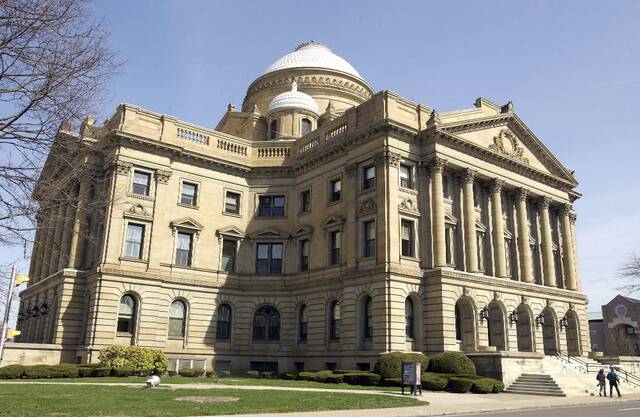
Luzerne County Courthouse
File Photo
The revenue would fund blight demolition
Luzerne County Council is considering a $15 fee on deeds and mortgages recorded in the county to establish a blight demolition fund.
Council discussed the proposed ordinance at this week’s work session, which means it may be introduced at the May 12 meeting. Four of 11 council votes are required for introduction, and a subsequent public hearing and majority passage would be necessary for the fee to take effect.
A fee was suggested in 2017, but council did not advance the proposal at that time due to concerns about the added burden on those buying and refinancing houses.
State Act 152 of 2016 authorized counties to impose the fee. Revenue must be segregated and used to combat derelict properties that depreciate neighboring property values and jeopardize the public’s health, safety, and welfare, the work session agenda said.
As an example of the potential revenue, a total of 9,279 deeds and 8,682 mortgages were recorded in the county in 2025, which would have generated $269,415 if the fee had been in effect last year, the administration said.
Council Chairman Jimmy Sabatino said state Sen. Dave Argall, R-Pottsville, advocated implementation of the fee in this county. Argall has prioritized blight reduction as a legislator.
Blight remediation funds are needed now that council is reactivating the county’s Blighted Property Review Committee, Sabatino said during the work session. When the committee last met years ago, it was working to compile a countywide blighted property database that never got off the ground.
A county land bank Sabatino and others want to create would also benefit from the funds, he said.
Authorized by 2012 state legislation, land banks take possession of rundown parcels and attempt to get them back into productive hands. At least 17 of the county’s 76 municipalities are in land banks. The county bank would assist municipalities not in such programs, officials said.
A county land bank also could address properties that have been stuck under county ownership or in the county’s delinquent tax repository with no interested buyers, Sabatino said.
Sabatino said he held off on further discussion about the land bank so the county’s new Community Planning and Economic Development Division could get involved. Ted Ritsick, who was hired to oversee the division on April 14, is “well-versed” in land banks, he said.
“We’re trying to build out a system that can really benefit county residents,” he said of the blight reduction plans.
Council Vice Chairwoman Brittany Stephenson said the demolition fund would be a “foundational piece to make sure the blighted committee can operate.”
“This will be an immense support and something I believe we should move forward with,” Stephenson said.
Councilman Harry Haas said he’d like to see data on blighted properties within the county because he suspects there are fewer problem structures than in the past.
“Just driving around our municipalities, there are just less blighted properties because so many newcomers have come in, and they have actually rehabilitated a lot of our housing stock. That’s a very positive thing,” Haas said.
Stephenson said data collection will be a focus of the blight committee.
Councilwoman LeeAnn McDermott noted council had approved a different blight reduction fee in November.
That ordinance, allowable through state Act 48 of 2024, adds a $100 fee on each property sold in delinquent tax claim auctions and sheriff mortgage foreclosure sales.
Due to the timing of these auctions and sales, fees have only been imposed on approximately 16 properties to date, officials said. The major annual tax auctions are in August and September.
These funds must be deposited in a segregated, interest-earning bank account for demolition and rehabilitation projects.
Regarding the proposed new fee, those recording deeds and mortgages must currently pay $72.75 in state and local fees, independent of the realty transfer tax that applies to purchases.
The breakdown, according to the county Recorder of Deeds Office:
• State — a $0.50 writ tax and $41.25 fee for two judicial-related accounts that fund statewide criminal case management systems and provide civil case legal representation to the poor.
• County — a $13 base recording fee to offset deed office operation costs; a $3 recorder’s archive fee to automate and scan records and buy computers and other equipment in the county deeds office; a $2 archive fee for other county offices primarily tapped to pay for county record storage space; and $13 for a Housing Trust Fund the county implemented in 2003 to provide matching funds to income-eligible, first-time home buyers and other affordable housing initiatives.
Reach Jennifer Learn-Andes at 570-991-6388 or on Twitter @TLJenLearnAndes.