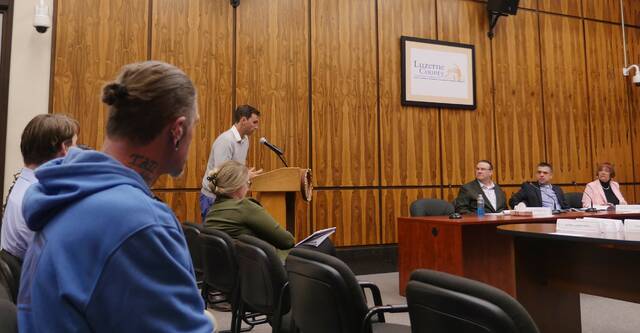
XT Enterprise founder Adam Lorts updates Luzerne County’s opioid commission Wednesday on his recovery house in Wilkes-Barre. Recovery house program participants Mark Murphy, in the foreground, and Elijah Nicewonger, seated to his left, also spoke Wednesday on how the facility has helped them maintain long-term sobriety.
Jennifer Learn-Andes | Times Leader

XT Enterprise founder Adam Lorts briefs Luzerne County’s opioid commission Wednesday on the success of his recovery house in Wilkes-Barre, which received a $54,000 opioid funding award. The commission members shown, from left: Acting Correctional Services Division Head Stanley Fiedorczyk, county Drug and Alcohol Administrator Michael Gagliardi, citizen member Mary Butera, and county Human Services Division Head Megan Stone.
Jennifer Learn-Andes | Times Leader
Luzerne County Council approved two new opioid settlement awards on Tuesday and advanced an ordinance that would add two more council members to the panel that makes funding recommendations to council.
This panel — the Commission on Opioid Misuse and Addiction Abatement — also met on Wednesday to review a new funding request and hear a presentation from a prior funding recipient about the success of its substance use disorder recovery house.
The two earmarks council unanimously approved Tuesday:
• $60,000 to the Children’s Service Center of Wyoming Valley to help with patient insurance copay and deductibles required for them to continue substance use disorder treatment
• $268,600 to help renovate and support the Clem-Mar House-Meridian Recovery House in Wilkes-Barre that will serve up to 30 women in recovery
Ten of 11 council members voted to introduce the ordinance restructuring the commission, which means the proposal will proceed to a public hearing and final vote. Councilman John Lombardo provided the lone no vote.
Created by council in 2023, the commission currently has seven members: a council-appointed citizen (Mary Butera), a council member (Lombardo), the county district attorney, and four administrators — the manager, drug and alcohol director, and human services and correctional services division heads.
Council has the final say on which awards are granted.
Councilwoman Denise Williams proposed adding two more council members, saying more representation from the legislative branch is warranted.
If the ordinance takes effect, the seat currently held by Lombardo would be vacated and subject to reappointment, it said.
Council has authorized approximately $8 million in earmarks since 2023. The county is projected to receive approximately $30 million over 18 years from the state’s settlement against opioid manufacturers and wholesale distributors.
Commission meeting
Commission members tabled a decision Wednesday on whether to recommend awarding $130,000 to the Dallas Township Police Department for a community narcotics detection K-9 program.
The earmark would help fund acquisition and training of the canine, training of a handler, and purchase of a specially equipped K-9 police vehicle, the submission said.
Butera raised concerns the K-9 program would not qualify under settlement fund eligibility requirements.
County District Attorney Sam Sanguedolce also said he wants to get a better handle on K-9 units throughout the county — including which law enforcement entities have them and what geographic locations they serve — to ensure there is no excessive overlap.
The DA also said he wants to verify K-9 units are keeping up with extensive training and other requirements for the canines to remain on active duty.
He stressed he was not suggesting Dallas Township would fail to comply with requirements.
Sanguedolce and other members also said they want to hear from township police representatives.
The commission unanimously voted to table the request and invite the department to its public meeting in June.
County Manager Romilda Crocamo, who chairs the commission, suggested waiting until June because additional council members should be on the commission by then if council approves the restructuring plan.
Recovery house
Council had unanimously voted in October to award $54,000 in opioid funds to XT Enterprise, also known as RecoverU, a housing program that supports those recovering from substance use disorders.
XT Founder Adam Lorts said the 10-bed, state-licensed recovery house on Barney Street in Wilkes-Barre has been operating for a little over six months, with more than 90% of the residents maintaining sobriety and achieving milestones such as regaining custody of children, obtaining employment, and stabilizing finances.
Lorts, who is in long-term recovery, said the house is managed by Steve Loftus, requires random drug testing, and has 24/7 security.
The men said the majority of residents have opioid use disorder.
Two program participants spoke Wednesday — 22-year-old Elijah Nicewonger and Mark Murphy, 43 — to explain how the program helped them stay sober as recovering alcoholics.
Nicewonger is from North Carolina and said he chronically relapsed after repeated attempts at rehabilitation programs. After completing a treatment program in Schuylkill County, he came to the Wilkes-Barre recovery house to “start fresh” instead of returning to his home state.
He now works two jobs, has a savings account for the first time, and has been sober for approximately 14 months.
“I’ve become somebody that I can look in the mirror at and be proud of, and it’s thanks to RecoverU. I’m now grateful to call myself a resident of Luzerne County and in recovery,” Nicewonger said.
Murphy said he was in rehabs at least two dozen times but has stayed sober for a year largely through the support he received at RecoverU.
The recovery house was patient as he worked to get caught up on his weekly rent before he secured a job, alleviating a “huge” pressure early in recovery, he said. Murphy is now present for his 2-year-old son, which is particularly important at this time because the boy’s mother is currently struggling and incarcerated, he said.
“I’m really grateful to God that I’m able to be there for him,” Murphy said. “His mother may not be there right now, but his father is.”
Lorts said he plans to acquire another property to provide an additional eight recovery beds, noting there is a strong need for more recovery housing in the county.