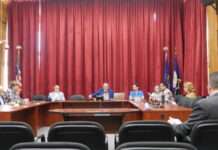
Luzerne County Courthouse
File photo
Luzerne County’s bipartisan Election Task Force released eight recommendations for Pennsylvania to improve election procedures.
State senators and representatives have been invited to a public briefing on the suggestions on Thursday night.
County Manager Romilda Crocamo formed the citizen group after the 2024 general election to identify state election code updates and other changes that will be pitched to state legislators.
The recommendations and some background:
• Adjust the mail ballot application deadline
Voters have until a week before the election to apply for mail ballots, and election officials across the state have argued this window is too short for voters to receive and return their ballots.
The task force suggests a deadline of two weeks before the election.
Since the implementation of mail ballot voting in 2020, thousands of voters who waited until the final week before the deadline have failed to receive their ballots on time, the task force report said.
Although the U.S. Postal Service has indicated ballots can be delivered within 48 hours, barcode tracking and direct voter communications show actual delivery to voters typically takes five to seven days, in addition to the same span for completed ballots to arrive back in the election bureau, it said.
“This delay often results in voters being unable to cast their ballots, creating a de facto disenfranchisement. While unintentional, the current deadline is logistically impractical and undermines voters’ ability to exercise their rights,” it said.
• Allow mail ballot processing sooner
Counties must wait until 7 a.m. on Election Day to open and prepare mail ballots for scanning, known as pre-canvassing. Permitting counties to start pre-canvassing sooner would reduce administrative strain and ensure that results are tallied without delay, election officials have argued.
Extending the pre-canvassing period several days would address candidate concerns about late results caused by overnight or multi-day ballot processing and “enhance public confidence” through timely reporting of results, it said.
• Update outer mail ballot envelope to include designated agent information
Under state law, voters are only allowed to mail or hand-deliver their own ballot unless they are serving as a designated agent for someone with a disability.
Disabled voters must fill out an official designated agent form authorizing someone to deliver their ballot for them, but there is no set procedure on what to do with these forms, other than advising agents to have a copy on hand in case they are questioned when they are delivering a ballot to the county.
The task force proposes adding a section on the back of the affirmation envelope authorizing a designated agent to deliver ballot materials on behalf of that voter.
“This enhancement would be particularly beneficial for counties utilizing drop boxes, streamlining the process and reducing administrative burdens,” the report said.
• Simplify provisional ballot procedures
Provisional paper ballots are cast at polling places, usually when workers determine that additional voter verification is needed. The county reviews provisional ballots last to ensure the voters are properly registered and did not cast a second ballot by mail.
After every election, the county’s five-member Election Board (all citizens) encounters signature problems and other issues with provisional ballots during its adjudication review.
While the Pennsylvania Department of State improved provisional ballots with its 2025 affirmation envelope redesign, further legislative changes are needed to define procedures for processing and counting these ballots, the report said.
The task force recommends offering “clear resources for voters, poll workers, and county boards, especially during court challenges like those seen in 2024.”
• Require only one signature on provisional ballots
The law requires voters to sign the provisional ballot affirmation envelope twice — once before voting and again after sealing the ballot.
This requirement often causes confusion and leads to ballot rejection, the report said.
“Removing the legal requirement for the second signature reduces voter errors and missed steps, increases acceptance rates for otherwise valid provisional ballots, and simplifies the process for voters and poll workers,” it said.
• Increase state financial support for elections
State funding from the Election Integrity Grant is appreciated, but additional resources are needed to meet election obligations, including poll worker training, security measures, and additional staffing during high-volume election periods, the report said.
• Update recount procedures
The task force advocates modernizing the election code to establish uniform, statewide recount procedures to reduce unnecessary delays.
This is needed to help candidates and “reduce administrative burdens caused by repetitive or meritless petitions,” it said.
• Replace the state voting database as soon as possible
County election officials have complained about the state’s voter database used by all 67 counties, known as the Statewide Uniform Registry of Electors, or SURE, system. The state had announced plans in March 2025 to implement a new streamlined elections management system that would eventually replace SURE and other current elections-related programs.
The task force said it is “critically important” that the transition occurs “sooner rather than later,” citing significant processing delays “due to system limitations.”
“The current SURE system was not designed to handle the expanded demands of Pennsylvania’s modern election process,” it said.
Thursday’s public session with legislators is at 6 p.m. in the county courthouse on River Street in Wilkes-Barre.
Task Force member Linda Joseph, of Wilkes-Barre, has said the group’s focus was on improving the state law governing election procedures, not on internal bureau operations. She has emphasized that the group’s determination of the eight recommendations was bipartisan.
The full report is posted on the main page at luzernecounty.org.
Reach Jennifer Learn-Andes at 570-991-6388 or on Twitter @TLJenLearnAndes.