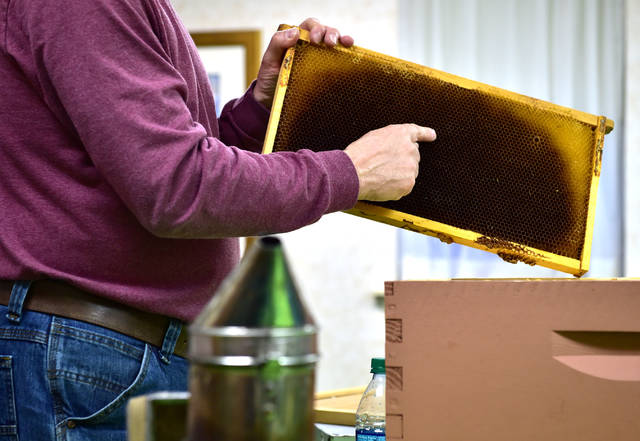
DALLAS — It takes two million flowers to make a one pound bottle of honey, Master Beekeeper Frank Licata said at a presentation at the Back Mountain Memorial Library March 29.
“In its lifetime, a worker bee will make one twelfth of a teaspoon of honey,” Licata said. “When they get to that forging phase, they die because they wear out their wings.”
It seems like a big job for a tiny insect to visit flowers, mix an enzyme with nectar to make a small bit of honey while raising youngsters. But when the entire hive is involved, the process is smoother than any factory production line.
Licata, operations managers for Mann Lake Ltd., a beekeeping supply service in the Hanover Industrial Park in Hanover Township, discussed the honeybees’ life cycle and the threats to honey bees with 23 guests at a free presentation at the Back Mountain Memorial Library in Dallas Wednesday.
“They are amazing the way they work,” Licata said.
Bees do not operate individually but the hive works together as “one organism,” quite a feat considering the insects do not communicate by sound, he said.
“Honeybees do not speak, but each one knows its job,” said Licata.
Queen
There is only one queen at a time in a hive and her only job is to lay eggs, Licata said.
“She will lay 2,000 eggs in a day,” Licata said.
The queen’s physiology differs from a worker bee in one way. Her abdomen is larger due to a fully developed reproductive organ created by a consistent diet of royal jelly, he said.
The brood, during the infancy stage of a bee’s life, are fed royal jelly for the first three days, Licata said. Then, the worker bees or nursemaid bees, begin feeding the larva “bee bread,” a combination of pollen and honey, he said.
The diet stunts the growth of their reproductive organs, he said.
If the queen bee dies, worker bees will seek out the youngest larva and feed it royal jelly to create a new queen, Licata said.
“It is like all of us; if we eat a diet of one cheeseburger a day, we will be fine but if we eat 10 we would get pretty big,” he said. “They want that queen to be well fed and big, so they feed her a lot of royal jelly.”
Licata said worker bees will start to develop 10 to 15 new queens at this time in case something goes wrong.
“We now have 10 to 15 queens ready to hatch,” he said. “We are only allowed to have one in the hive; the first queen that hatches calls to her sisters. It’s called piping.”
“They answer back.”
The queen will go over to the cells her sisters are in, chew a hole in them and sting them to death, he said.
Licata said the virgin queen will stay in the hive for a few days before heading out to orient with the hive and mate.
When the queen ventures out on her first flight, she first flies around the hive. Then, while releasing a pheromone, she seeks out the drone congregation area, he said.
Drones
Drones are the only male bees in the hive, Licata said. The are made from unfertilized eggs.
A drone’s only job is to mate with a queen, he said.
“What do they do in a hive – absolutely nothing,” Licata said. “They hang around the hive all day, beg their sisters to be fed, and they are the only bee that can go into any hive in an apiary.”
“They are like teenage boys. All they want is to be fed, go to their buddy’s house and look for girls.”
Drones leave the hive daily and hang out in the drone congregation area, waiting for a virgin queen, he said.
When a queen flies by, the drones pick up on the scent and chase after her, Licata said.
“There are probably 20 to several hundred drones following her,” he said. “They follow her like a comet.”
When the first drone approaches the queen, she opens her sting chamber to for him to insert his reproductive organ, Licata said. When the drone is finished, his abdomen is ripped “from his body and falls to the ground dead,” he said.
“Males are dumb so the guy behind him goes ‘sorry for him that’s not going to happen to me’ and follows right up and does the same thing over and over 12 to 20 times,” Licata said. “The males are dead and the queen is successfully mated. Life goes on.”
Worker bees
Worker bees, all females, do all the work in the hive, Licata said.
“Worker bees are the ones that really keep the hive going,” he said.
During its three-week life span, a worker bee has several jobs. The first job is cleaning and polishing cells for the queen to lay eggs in, he said.
In a few days, the worker bee’s hypopharyngeal glands in their head develop, allowing it to make royal jelly, Licata said. At this point, the bee’s job evolves into a nursemaid bee feeding the larva.
“After a few days, that gland will stop functioning,” he said. “Then they become, what we call, ‘queen’s attendants.’”
Licata said worker bees will clean, groom, feed and remove the queen’s waste. Caring for the queen allows her pheromone to pass through the hive, he said.
“The hive always knows when it has a queen and when it doesn’t,” he said. “If I removed the queen from a hive within two hours, the hive would know it was queen-less and get very nervous and agitated; that lack of pheromone makes them very anxious.”
In a few days, the worker bee will become a wax maker as its wax glands begin to function, Licata said.
“As they take in nectar, they start shedding wax scales,” he said. “They need to eat nine pounds of honey to make one pound of wax.”
At this point, bee jobs vary from undertaker bees who remove dead bees from the hive, and receiver bees or pollen packer that accept nectar and pollen from foraging bees and store it in a cell.
Other bee jobs include guard bees and foragers.
Foragers collect four things, nectar, pollen, water and propolis, a resin from plants and trees that has anti fungal and anti-bacterial properties, Licata said.
Licata said bees coat everything in the hive with propolis to keep disease out.
Bee threats
“Honey bees are in trouble for several reasons,” he said. “All of our native pollinators are in trouble.”
One reason is due to the lost of small farms that planted a variety of crops and the growth of large farms that focus on one crop, such as the almond farms in California, Licata said.
“Everyone here would love to eat a lobster for dinner but you would not want to have lobster for breakfast, lunch and dinner every day of the week,” he said. “Number one you would not like it and two it is not good for you because it lacks diversity.”
“It is the same thing with honey bees.”
Pesticides known as neonicotinoids pose a serious threat to honey bees and other pollinators, Licata said. Neonicotinoids are nicotine based and systemic to the plant, he said. Plant seeds are coated with the chemical, which is absorbed by the vegetation.
“Even if a honey bee licks the dew from corn, it gets that pesticide,” Licata said. “If a bee takes the pollen from the corn, it gets that pesticide.”
The chemical affects the entire hive. It shortens the life span of the brood, drones suffer from sexual dysfunction plus the queen’s ability to reproduce is hindered, he said.
A third threat to the honey bees’ well-being is the Varroa Mite. The Asian mite is more like a tick in the way it attaches itself to a bee and sucks out the insect’s fat bodiess. The bee’s immune system is weakened, making it susceptible to diseases and shortens its life span, Licata said.
“Will we ever run out of honey bees – no,” he said. “Down in the southern states, they are consistently raising honeybees.”
“What we will run out of is the commercial beekeeper.”
Make a difference
There are steps local gardeners can take to aid the honey bee and other pollinating insects, Licata said.
First is to be aware of what you are planting. He said to chose seedlings and seeds that are pesticide free.
Second, encourage stores and greenhouse to sell neonicotinoid-free plants, Licata said.
Second, when planning out your garden, be sure to plant a variety of vegetation that will provide a diverse diet for honey bees, he said.
“Things like that can help,” he said.