DALLAS — Devin Oyola had his first experience with racism when he was in high school.
The Misericordia student from Ewing, N.J., had stopped on his way home from track practice to pick up a soda with a group of friends in his “primarily black neighborhood.”
Oyola, who is African-American, had a gym bag over his shoulder, and it was hanging down on his side. He went to the soda cooler and took out one soda. Then changed his mind and put it back and picked out a different one.
“The man at the counter wanted to search my bag,” Oyola said. “At first, I refused.”
The clerk was persistent and tried to grab the bag from Oyola.
“I let him search it,” he said. “I never went back.”
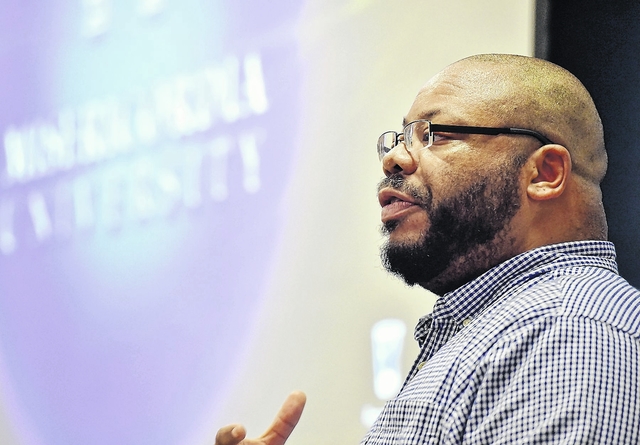
Oyola was one of four Misericordia students taking part in a panel discussion Tuesday on the Black Lives Matter movement, part of a week-long series of events to honor Martin Luther King Jr. and celebrate diversity.
Joining Oyola on the panel were Trever Reed, a sophomore from Gaithersburg, Maryland; Tyler Lamberson, a a senior from Allen, Texas; and Lena Williams, a junior from Harrisburg.
“The purpose of this event is not to discuss the (Black Lives Matter) movement but to share personal experiences and the importance of conversation,” Dan Kimbrough, assistant professor of communications at Misericordia University said. “If we are not having conversations, we are not learning.”
Reed, who described himself as mixed race, said racism is such an issue because our country was built on it.
Lamberson, who is white, said when he was a child at his grandfather’s restaurant, he noticed none of the waitresses and waiters were African-American.
All people of color were in the kitchen, he said. He questioned his grandfather.
“He said the black people belonged in the kitchen,” Lamberson said, noting he realized at that moment his grandfather’s point of view did not match that of his parents.
Kimbrough asked the students how they handled situations of racism.
“I am not a confrontational person,” Williams, an African-American, said. “I would remove myself from the situation. Let ignorance be.”
Reed said he would try to talk to the person.
Kimbrough asked the students for their ideas about the Black Lives Matter movement.
“I believe it started with good intentions, but it is unorganized,” Williams said. “Some people use the term but do not understand the movement’s core values. They need to denounce extremists.”
Oyola said he believes the movement helps raise awareness about issues and “builds peoples’ knowledge,” helping to develop positive attitudes.
“It has its flaws but has a purpose to bring awareness of police brutality,” Reed said.