Luzerne County’s adult treatment court team meets for hours every Friday to review client case files at the courthouse. Shown clockwise, from the foreground at left: Tim Hlivia, probation officer; Maura Tunis, county defense attorney; Jennifer Weiss, senior probation officer; Laura Biga, lead treatment court case manager; Shannon Lai, treatment court case manager; Amanda Frandella, an addiction medicine fellow participating as an observer; Pat Matteo, a Volunteers of America representative assisting the team with housing matters; Princess Morgan, county prison treatment coordinator; Alex Zupancic, Wyoming Valley Drug and Alcohol Services counselor: Allyson Kacmarski, county DA’s Office specialty court programs division chief; Aleesha Whitaker, assistant coordinator of treatment coordinators; Danielle T. Goldowski, county treatment courts coordinator; and county Court of Common Pleas Judge Joseph F. Sklarosky Jr. Shown on the remote screen at the rear is Jill Sprau, county drug and alcohol assistant administrator.

Certificates were on display in the Luzerne County Courthouse rotunda for last week’s adult treatment court graduation.
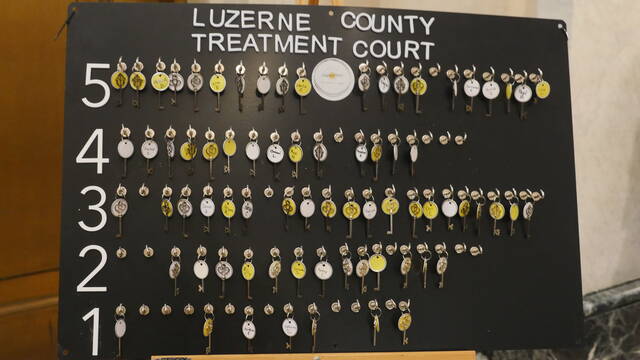
Luzerne County adult treatment court participants move progression keys on this board as they advance through five phases to graduation.

Luzerne County Treatment Courts Coordinator Danielle T. Goldowski addresses program graduates during last week’s graduation ceremony in the courthouse rotunda.

A large crowd filled the Luzerne County Courthouse rotunda and surrounding hallways for last week’s adult treatment court graduation.

Luzerne County Court of Common Pleas Judge Joseph F. Sklarosky Jr., in the foreground at right, and county First Assistant District Attorney Anthony Ross, at left, present a certificate to an adult treatment court graduate in the courthouse rotunda last week.

Michele Rosemellia and her daughter, Layla, brought gift bags to last week’s Luzerne County adult treatment court graduation to acknowledge those completing the program.
Every Friday, Luzerne County Court of Common Pleas Judge Joseph F. Sklarosky Jr. and a team of a dozen or so huddle around a large table inside the courthouse for hours, often working through lunch.
The group intimately examines county adult treatment court case files to collectively assess which clients are staying sober and following plans designed to keep them away from drugs and alcohol.
One by one, team members share updates about their latest interactions and accounting of each client to conclude through majority decision if that person is getting by, progressing, or slipping back into concerning patterns that landed them in court in the first place.
The program, which takes at least 18 months to complete, is for those charged with non-violent criminal offenses related to or motivated by addiction to drugs or alcohol, said county Treatment Courts Coordinator Danielle T. Goldowski.
More than 250 people are participating in the adult treatment court, which also includes specialty programs focused on veterans and those with mental illness.
Among many requirements, participants must undergo frequent scheduled and random drug testing, complete intensive substance use disorder treatment, and regularly appear in court, initially at least once per week.
Sklarosky has the final say on which recommendations are carried out. Those who fail to comply with program rules will be sentenced for their charges. Clients who successfully complete the program will graduate and be eligible to have outstanding charges dismissed.
During the team’s May 22 review, the group decided many of the clients were on track to continue or advance to the next phase.
Team members expressed worries about one man who is feeling stressed out and overwhelmed. They planned to follow up to see if he needed additional support.
One client was put on watch for getting behind on community service.
Another client rectified his tardiness problem by working with the team to change the time of his case management appointments to better fit his schedule, those involved in his monitoring reported.
“He’s not giving up on himself. He keeps working. He keeps trying,” the judge said.
The team passed around a birthday card to sign for a client. They beamed during a report of another man’s move into a new apartment because the excited client had shared photos of household items he intends to use for many home-cooked meals.
Sklarosky said he recently noticed one client was smiling.
“Something is different with him,” he told the group.
Team members largely attributed the change to the man’s decision to complete additional trauma therapy on top of his mandatory program requirements.
The next client on the list was in compliance, but Sklarosky said he keeps thinking about him and hoping he remains strong.
“I think he’s a good kid, but if he gets in the wrong social environment, he is very easily influenced,” the judge said.
Although rare, the team agreed that one man should be removed from the program because he attempted to falsify a urine test and acted out when it was detected.
“This is a nonviolent offender program,” Goldowski said. “When someone exhibits violence, the treatment court won’t allow that for the safety of clients and staff members.”
In Court
With the reviews wrapped up, Sklarosky donned his robe and headed with the team to a nearby courtroom for a Friday evening proceeding.
Female clients appear before the judge first, followed by a session for the males.
One woman approached the bench and told Sklarosky she was “much better,” largely because she is now on the appropriate medication and residing in a group home with people to help her.
“All the stress is gone,” she told the judge.
In the male session, a man read a required essay to the group of approximately 30 other program participants in attendance. He received applause after speaking about his efforts to break old behaviors and reach out to his sponsor when he is struggling.
There were more claps for another man selected as the client of the week, and he told the judge he is working hard in his job and is up for a promotion.
Sklarosky congratulated the man but cautioned that vigilance is also necessary when things are going well.
“I take it one day at a time. I remember where I came up,” the man told him.
The client recommended for program termination during the earlier team meeting appeared before the judge. He apologized for his behavior, but the judge said he cannot remain in the program because violence is prohibited.
Graduation
There were many embraces and handshakes last week when 29 clients graduated at a ceremony in the courthouse rotunda.
Goldowski said those completing the tough program can “get through anything.”
“You earned this,” she said.
Sklarosky told attendees he was pleased to see a crowd celebrating and supporting the graduates.
He acknowledged the treatment court team and outside providers that work closely with them to help the clients, saying this county has one of the best treatment courts in Pennsylvania.
“They want each person to be the best they can be,” he said.
County First Assistant District Attorney Anthony Ross delivered the main address, commending graduates for their perseverance and resiliency.
“You are the proof that nothing is impossible,” Ross said.
One graduate spoke of his decade-long addiction during the ceremony, saying it controlled his life, created legal issues, and made him lose sight of the person he wanted to be.
Although skeptical at first, he said he stuck with the treatment court program and learned how to rebuild. He encouraged court participants attending the graduation as observers to stay connected, trust the process, and be honest.
“Treatment court didn’t just help me get sober. It helped me get my life back,” he said.
The county’s treatment court program is accredited by the Pennsylvania Supreme Court. Accreditation is awarded to programs that adhere to key drug court protocols and evidence-based best practices.
State Supreme Court Justice P. Kevin Brobson is scheduled to present the county’s treatment court certification during a ceremony in the courthouse rotunda at noon on Friday.
Brobson held a town hall last week to recognize May as “National Treatment Court Month,” featuring treatment court partners, including Sklarosky.
More than 130 treatment courts are operational across the state, according to a release.
“Treatment courts are based on a powerful idea — that we can’t incarcerate our way out of addiction, mental illness or trauma,” Brobson said in a release. “When we combine accountability with compassion through the treatment court program, lives are changed and saved, and communities are strengthened.”
Reach Jennifer Learn-Andes at 570-991-6388 or on Twitter @TLJenLearnAndes.