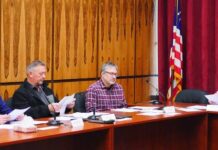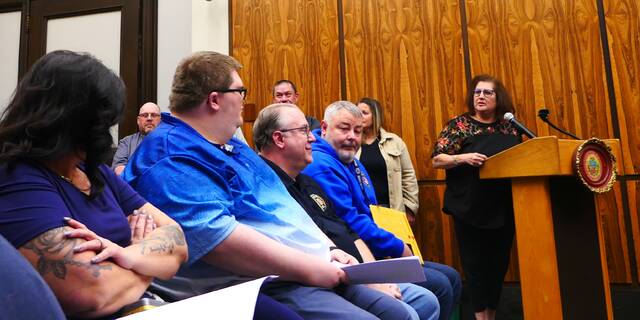
Luzerne County Emergency Services Director Lucille Morgan, at the podium, was honored with a proclamation during Tuesday’s County Council meeting for her recent award naming her 2026 ‘emergency manager of the year’ at the Lehigh Valley Emergency Services Conference.
Jennifer Learn-Andes | Times Leader
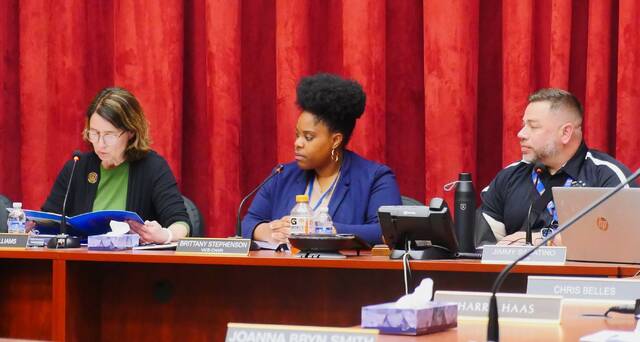
Luzerne County Councilwoman Denise Williams, at left, reads a proclamation during Tuesday’s meeting. Also shown are Council Vice Chairwoman Brittany Stephenson and Council Chairman Jimmy Sabatino.
Jennifer Learn-Andes | Times Leader
After hearing several citizen public comments for and against, seven of 11 Luzerne County Council members voted Tuesday to keep a proposed anti-discrimination ordinance on the table for further consideration.
The legislation would create a county human relations commission to rule on discrimination complaints that extend beyond county government and involve employment, housing, healthcare, education, and establishments offering goods and services to the general public.
At least four votes are required to introduce ordinances, which require a subsequent public hearing and final council majority approval to take effect.
The following Council members supported the introduction: Chairman Jimmy Sabatino, Vice Chairwoman Brittany Stephenson, Chris Belles, Joanna Bryn Smith, Dawn Simmons, Denise Williams, and Patty Krushnowski.
Those against introduction: Steve Coslett, John Lombardo, Harry Haas, and LeeAnn McDermott.
Seven citizens weighed in during Tuesday’s meeting — three in support and four in opposition. A citizen and a couple also submitted written comments against the proposal.
Critics have argued the ordinance is unnecessary because state and federal laws already prohibit discrimination, and they expressed concerns about added costs for investigations and confusion in carrying out the directive.
Supporters said added protections are needed to address omissions in state law and that county-level enforcement will address a state backlog in processing discrimination complaints.
Sabatino said the proposal will be discussed at council’s May 26 public work session, with a vote expected in June. He said he will also schedule a special standalone public hearing instead of holding it the same night council votes.
“Due to the wide, sweeping protections offered under this ordinance, I, as chair, want to make sure everybody has an opportunity to express their opinion on this ordinance,” Sabatino said.
Council also provided the votes needed to introduce an ordinance on Tuesday that would require the county manager to obtain advance council approval for: non-union compensation adjustments 5% above the amount authorized by the adopted position budget; net increases in the total number of county positions; and the creation of new management, supervisory, or department-level positions not expressly contemplated in the adopted budget.
Sabatino said council bylaws indicate there is no discussion at the time of ordinance introduction.
Seven council members voted for the introduction, with some saying they are not committed at this point but look forward to discussion: McDermott, Simmons, Bryn Smith, Stephenson, Williams, Belles, and Sabatino.
Those voting against introduction: Lombardo, Coslett, Haas, and Krushnowski.
County Manager Romilda Crocamo said after the meeting the proposed ordinance is “precisely the kind of interference in day-to-day operations” that the county’s home rule charter was “specifically designed to prevent.”
Council also unanimously introduced three other ordinances on Tuesday that would:
• Impose a $15 fee on deeds and mortgages recorded in the county to establish a blight demolition fund
• Amend the county zoning ordinance to require a buffer yard of at least 30 feet when new industrial development abuts residential areas
• Amend the county’s Subdivision/Land Development Ordinance, known as SALDO, to require developers of large-scale projects on public transportation routes to seek input from the county Transportation Authority or Hazleton Public Transit so the plans incorporate suitable accommodations for buses and their passengers, including school buses
Opioid funds
Another ordinance was adopted Tuesday changing the structure of the commission that makes recommendations to council on the use of opioid litigation settlement funds.
Approved by 10 council members with a lone no vote from Lombardo, the ordinance will increase the number of council members from two to three on the Commission on Opioid Misuse and Addiction Abatement.
The commission seat currently held by Lombardo will be vacated and subject to reappointment.
Sabatino said he will serve in the commission seat reserved for the council chair or the council chair’s designee, and he will nominate Bryn Smith and Stephenson for council consideration to fill the other two seats. A majority vote would be required for those two appointments.
Created by council in 2023, the commission currently has six other members: a council-appointed citizen (Mary Butera), the county district attorney, and four administrators — the manager, drug and alcohol director, and human services and correctional services division heads.
Council also unanimously approved three commission-recommended opioid fund earmarks on Tuesday:
• $2.2 million for 2027 and 2028 costs of injectable medications and other expenses related to the county prison system’s medication-assisted treatment program
• $172,000 for the county’s adult treatment court to partially cover the salaries of two case managers, a probation officer, and the treatment court coordinator
• $282,551 for The Wright Center for Community Health’s ongoing recovery “Healthy MOMS” program to continue providing medication-assisted treatment for pregnant and postpartum women and expand treatment for babies born with neonatal abstinence syndrome
Council also unanimously voted to approve new collective bargaining agreements with workers in three human services departments represented by Teamsters Local 401: Children, Youth and Families; Mental Health/Developmental Services; and the Area Agency on Aging.
Reach Jennifer Learn-Andes at 570-991-6388 or on Twitter @TLJenLearnAndes.