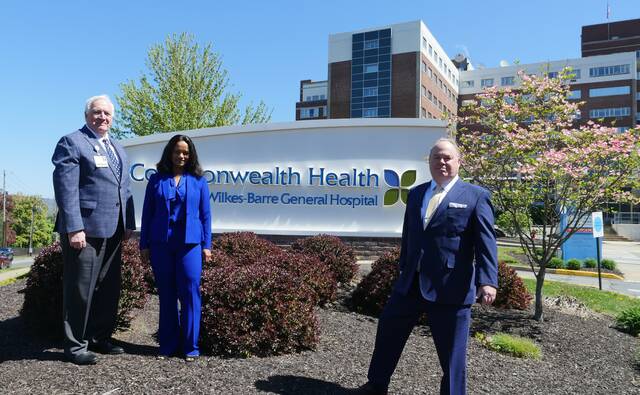
As Wilkes-Barre General Hospital nears a 90-day milestone under new ownership, the facility’s leadership spoke about its progress Monday. From left are: Commonwealth Health President Michael Clark, Tenor Health Foundation Chief Executive Officer Radha Savitala, and Commonwealth Health Vice President of Clinical Services Patrick Conaboy.
Jennifer Learn-Andes | Times Leader
Wilkes-Barre General Hospital overseers discuss the transition to new ownership
As Wilkes-Barre General Hospital nears a 90-day milestone under new ownership, the facility’s leadership spoke about its progress Monday.
The nonprofit Tenor Health Foundation acquired Commonwealth Health on Feb. 2. The network also includes two Lackawanna County facilities — Regional Hospital of Scranton and Moses Taylor Hospital — as well as related physician practices and clinics, ambulatory surgical centers, and outpatient services.
The future of all three hospitals had been uncertain, and a prior purchase attempt by another nonprofit had fallen through in 2024.
Led by Chief Executive Officer Radha Savitala, Tenor was established to own and operate financially struggling hospitals, ensuring access to health care in communities at risk of hospital shutdowns.
“Ninety days in, it’s looking promising,” Savitala said Monday, citing success in recruiting additional primary care and specialist providers and emerging partnerships with colleges to address other staffing needs.
“Whether it’s employees or doctors or the community at large, everybody wants to be part of the growth,” she said.
Dr. Patrick Conaboy, vice president of clinical services at the restructured Commonwealth Health, said he has witnessed the lifting of the sense of a “black cloud” that “there may not be a tomorrow” for all three hospitals. That cloud was darker in Lackawanna County but also hung over Wilkes-Barre General, he said.
Commonwealth Health has been “bombarded” with responses to its request for physicians in the first 90 days, prompting Conaboy to conclude that the recruitment barrier was the uncertainty and prior ownership by a subsidiary of the for-profit Community Health Systems — not the actual facilities or their Northeast Pennsylvania location, he said.
“Now, with the help of Tenor, there’s a clear path forward. They’re beating a path to our door, and really one of the most shocking things in the last 60, 90 days for me is how much people do want to come here to work,” Conaboy said.
Previously, many hospital physicians had stopped showing up to group meetings because they were “disheartened,” he said. In comparison, a recent physician session drew 110 doctors attending to ask questions and comment, he said.
“It showed they’re invested, and they wanted to know what they could do to help. It was really an amazing meeting,” Conaboy said.
The three hospitals remain under the Commonwealth Health name, and Conaboy said they are working to make it one regional group instead of competing against each other.
Commonwealth Health President Michael Clark, previously Wilkes-Barre General Hospital’s CEO, said the company also plans initiatives to celebrate the many longtime employees and inform the public about awards the hospitals have received, including those for stroke care and cardiology.
“Those things are time-dependent,” Clark said of strokes and heart attacks.
“Without these facilities… well, I don’t even want to think about it,” he said, thinking back to past fears of hospital closures.
Savitala said Commonwealth Health, under Tenor, will be doing a better job of “showcasing our accolades” so residents are aware of the quality of providers and care and the longevity of the workforce.
“As community hospitals, this is what we’re doing. You’re not just a number, whether you’re a patient or employee,” Savitala said.
If the hospitals had shut down, existing facilities in the area would not “have been able to absorb all of that care,” she said, citing a collective total of 700,000 patient “encounters” at the three facilities annually, with many deemed “life-saving.”
Conaboy noted Wilkes-Barre General logs approximately 35,000 emergency room visits annually.
While Tenor has the expertise to run the hospitals as efficiently as possible without compromising care, community support is needed to keep them strong, Conaboy said. Insurance reimbursements don’t cover the full cost of providing care, and the nonprofit Tenor is not a hospital conglomerate with huge cash reserves, he said.
Examples of support could include fundraisers, grants, and foundation allocations, he said.
People also need to use the hospital services, Savitala said, noting patients may find they have shorter wait times.
Clark put it this way: “It’s Tenor that saved these hospitals. Now it’s up to the communities to keep these hospitals.”
Reach Jennifer Learn-Andes at 570-991-6388 or on Twitter @TLJenLearnAndes.