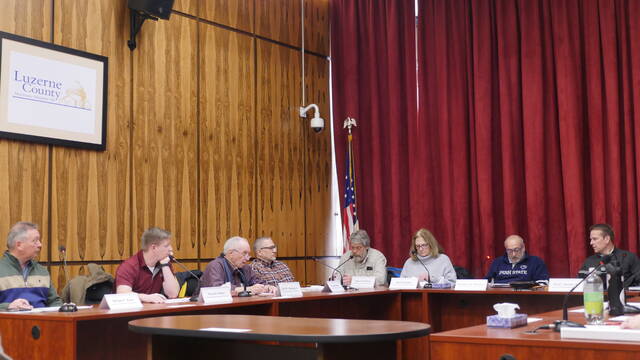
Luzerne County’s Planning Commission members are shown at a February meeting discussing a proposed county zoning amendment covering data centers.
Jennifer Learn-Andes | Times Leader File Photo
Luzerne County’s Planning Commission is scheduled to continue discussion Thursday on a data center zoning amendment that would apply to 19 municipalities.
County GIS, Planning, and Zoning Director Dan Reese said his office is recommending several revisions since the proposed amendment was last publicly discussed at the commission’s March meeting.
He expects the commission will wait until its May 14 meeting to vote on the amendment to ensure all wording and requirements have been exhaustively considered. Reese said he wants to avoid having to revisit the matter down the road because something was missed.
The commission votes on whether to advance county zoning ordinance amendments to county council, which has the final say. Because the amendment involves an ordinance, council would have to introduce it and then hold a public hearing and final vote at a subsequent meeting for passage.
If approved by council, the amendment will take effect in the following municipalities that rely on county zoning instead of handling it on their own: the boroughs of Avoca, Courtdale, Dupont, Duryea, Hughestown, Jeddo, Laflin, New Columbus, Pringle, Warrior Run, West Wyoming, and Yatesville, and the townships of Conyngham, Fairmount, Hunlock, Huntington, Lake, Ross, and Union.
Newport Township is also on the list, but the municipality is in the process of switching to in-house zoning control.
No data center requests are pending in these municipalities, Reese has said.
Suggested changes since the March meeting include increasing the required landscape buffer width from 50 to 100 feet.
Landscape buffers would be mandated between data centers and public roadways, zoning districts with residences, and “sensitive receptors,” such as schools and childcare facilities, nursing homes, churches, community centers, and conservation and agricultural land.
Reese said 100 feet was required in some of the additional zoning ordinances his office recently reviewed from other jurisdictions.
These buffers must include a mix of trees and shrubs, including a large evergreen tree in each 25-foot segment of the buffer, a deciduous shade tree every 75 feet, and an ornamental flowering tree every 50 feet.
The provisions state that trees and shrubs must be replaced if they die within 18 months or are not growing properly, in the county’s opinion.
Since March, Reese has also added wording setting deadlines for such replacement plantings.
A new section was also added, allowing data center developers to use existing trees and vegetation to comply with the buffer mandate if they demonstrate through plans and field verification that the “existing conditions provide substantially equivalent year-round screening.”
Regarding water usage, wording was added since March, requiring the data center to submit a drought contingency plan that would be enacted if the county declares a water shortage due to a drought emergency.
In the aesthetics section, the updated version said all lighting equipment must be fully enclosed or shielded.
“All exterior lighting shall utilize full-cutoff, downward-directed fixtures. No light source shall be visible from adjacent residential properties,” it said.
The updated document, with changes underlined in red, is posted in the commission meeting docket in the county meeting agenda section at luzernecounty.org.
Thursday’s commission meeting is at 2 p.m. in the county courthouse on River Street in Wilkes-Barre.
Separate from the data center addition, two other proposed zoning amendments are on Thursday’s commission agenda for its review.
One would cover battery energy storage systems, which are standalone units that kick in when electrical grids need a boost. The proposed amendment would require a zoning permit for systems with an aggregate energy capacity exceeding 600 kilowatt-hours.
The other would require a buffer yard of at least 30 feet when new industrial development abuts residential areas. The buffer yards would not apply to existing industrial properties unless they are proposing an expansion of more than 50%, the document said, which is also attached to the agenda.
The screened buffer may consist of a masonry wall, wood fence, trees, shrubs, berms, or a combination.
Reach Jennifer Learn-Andes at 570-991-6388 or on Twitter @TLJenLearnAndes.