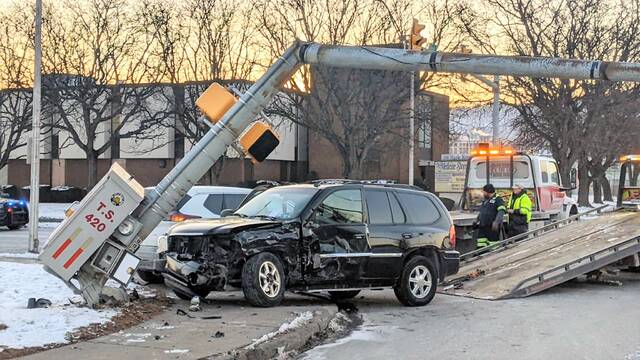
A traffic signal was knocked out of service when two vehicles collided in January 2025 at Hazle Street and South Pennsylvania Avenue in Wilkes-Barre. Luzerne County recently completed a 218-page, grant-funded assessment of roadway safety concerns and how to address them.
Ed Lewis | Times Leader file photo
Luzerne County officials completed a 218-page, grant-funded assessment of roadway safety concerns and how they can be addressed.
This safety action plan examines all roadways passing through the county — state, county, and municipal — and is packed with photographs and data.
It found the county had 170 traffic fatalities and 552 suspected serious injuries during a five-year period — statistics that show why the study was needed, project consultant Jeff Riegner, of Kittelson & Associates Inc., recently told County Council.
These deaths and injuries from 2019 through 2023 were the most recent statistics available during the study completion window. They are more than the dots shown on a map in the report, Riegner said during the council work session presentation.
“They are people who died as a result of traffic crashes, or were severely injured, and their families have had to deal with those issues potentially for years thereafter,” Riegner said.
They were also among more than 16,000 crashes during that five-year period, he said.
“So clearly there is an opportunity for improvement,” he told council.
Funded by a $200,000 Safe Streets and Roads for All grant from the U.S. Department of Transportation, the plan’s completion increases eligibility for future grant funding to advance safety improvements, officials said.
A safety working group of approximately 30 government representatives and community groups from throughout the county provided additional insight on safety concerns, Riegner said.
Feedback also came from nearly 600 public survey responses and comments provided at outreach events conducted by the county GIS, Planning and Zoning Department, which spearheaded the grant application and study.
The working group established a “fairly aggressive goal” to reduce fatalities and serious injuries by more than 50% by 2035, he said.
County GIS, Planning and Zoning Director Dan Reese asked council to adopt the plan at its next meeting on April 14 to help the county, state, and municipalities reach the 50% reduction goal. Council Chairman Jimmy Sabatino said the matter will be on that voting agenda.
Reese encouraged all municipal officials and residents to review the plan, which is posted on his department’s page at luzernecounty.org.
Wilkes-Barre Fire Chief Jay Delaney, who was on the study working group, said the plan is comprehensive and should “save lives.”
“All this data was collected, and if they can use it to save one life, it was well worth it,” Delaney said. “The study was designed to try to make these problem areas safer.”
Crash data revealed that most problems were in urban zones, particularly in the Wilkes-Barre and Hazleton areas, the plan said.
“This pattern is consistent with denser urban networks where closely spaced intersections, higher access density, and mixed land uses increase conflict opportunities — especially along major urban routes,” it said.
The Pennsylvania Department of Transportation actively participated in the plan because it is responsible for most of the higher-volume roadways in the county, Riegner noted.
That includes Interstates 81 and 80, where some of the fatalities occurred.
“Their roadways show up disproportionately on the high-injury network, and they are diligently working on a very regular basis at dealing with traffic safety issues themselves,” he said.
In rural areas, screening identified priority corridors and intersections/ramps spread across multiple municipalities, some clustered along state routes — including Routes 115, 309, 424, 93, 940, 118, and 29 — and near interstate ramps.
U.S. Route 11 ended up with the most high-priority stretches with safety concerns, Riegner said. As a result, the consultant recommends a follow-up study solely on Route 11 from Plymouth to Pittston to further explore recommendations, he said.
The plan said a 12.5-mile portion of Route 11 runs through nine municipalities, with inconsistent numbers and widths of travel lanes, left-turn lanes, on-street parking, and speed limits.
“These changes in roadway characteristics can surprise travelers, especially those who are not familiar with the area, and anecdotal information gathered through plan development suggests that this may contribute to safety concerns along the corridor,” it said.
In addition to roadway reconfigurations and construction alterations, recommended safety improvements for roads throughout the county include “low-cost countermeasures,” such as signs, pavement markings, and traffic signal changes, Riegner told council.
Depending on the location, other suggestions in the report include flashing beacons, improved lighting, rumble strips, widened shoulders, flattened rural side slopes, and speed feedback signs.
The plan also advocates non-infrastructure safe driving education initiatives, particularly focused on young drivers and all drivers with cell phones.
Reach Jennifer Learn-Andes at 570-991-6388 or on Twitter @TLJenLearnAndes.