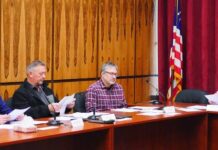
The Luzerne County Courthouse in Wilkes-Barre.
Times Leader file photo
The Luzerne County Commission on Opioid Misuse and Addiction Abatement’s regular Wednesday meeting will be open to the public for the first time — a change pushed by County Council members.
Council created the commission in September 2023 to review applications for county opioid litigation settlement funds and recommend awards for council’s consideration and final determination.
The commission took the position that its meetings were not public based on court case law because it is advisory and not a decision-making body. Instead, the commission held periodic public town hall meetings.
Councilwoman Denise Williams raised the issue at the March 10 meeting, saying she believes the commission’s work accepting, denying, and tabling recommendations falls under “official action” that should comply with open meeting laws.
County Manager Romilda Crocamo, who serves on the commission, said the panel will honor council’s desire to make the meetings public, starting with this week’s meeting.
Wednesday’s meeting is at 10 a.m. in the county courthouse on River Street in Wilkes-Barre. A link for the remote attendance option has been posted in council’s online meetings section at luzernecounty.org.
The county is projected to receive approximately $30 million over 18 years from the state’s settlement against opioid manufacturers and wholesale distributors.
Council has authorized approximately $7.7 million in earmarks since 2023 for a range of internal and outside projects, including programs that provide medication-assisted treatment at the prison, warm hand-off and recovery specialist services, recovery housing, and treatment and prevention education.
However, a council majority voted March 10 to table two new proposed earmarks pending a review of the commission structure and the way allocation recommendations are brought to council.
The commission has seven members, according to council’s ordinance creating it: a council-appointed citizen (Mary Butera), a County Council member (John Lombardo), the county district attorney, and four administrators — the manager, drug and alcohol director, and human services and correctional services division heads.
Based on a March 24 council work session discussion, council may add two more council representatives to the commission, for a total of three.
Williams also recommended wording requiring commission meetings to be public.
Council’s March 24 voting agenda included proposals to remove Lombardo from the lone council seat on the commission and appoint council Chairman Jimmy Sabatino to that seat.
After a lengthy discussion, a council majority kept Lombardo on the commission.
Lombardo described in great detail his intimate understanding of opioid use disorder from both working as a first responder handling overdoses and experiencing the loss of his cousin to addiction.
The six council members voting against removing Lombardo: Dawn Simmons, Steve Coslett, Harry Haas, Lombardo, LeeAnn McDermott, and Sabatino.
Those supporting the proposal: Joanna Bryn Smith, Vice Chairwoman Brittany Stephenson, Williams, Chris Belles, and Patty Krushnowski.
Williams and Krushnowski said they viewed the council representative change as part of council’s ongoing reorganization.
Bryn Smith and Belles said they strongly disagreed with the commission’s decision to hold closed meetings and challenged the legality. Belles also cited the absence of posted meeting minutes and the lack of an annual 2025 commission presentation to council as reasons a change was warranted.
Crocamo took responsibility for the meeting minutes not being posted and said the minutes are available online.
Lombardo asserted the attempt to remove him was “about power and control” and a “political hatchet job” that he described as “disgusting.”
Reach Jennifer Learn-Andes at 570-991-6388 or on Twitter @TLJenLearnAndes.