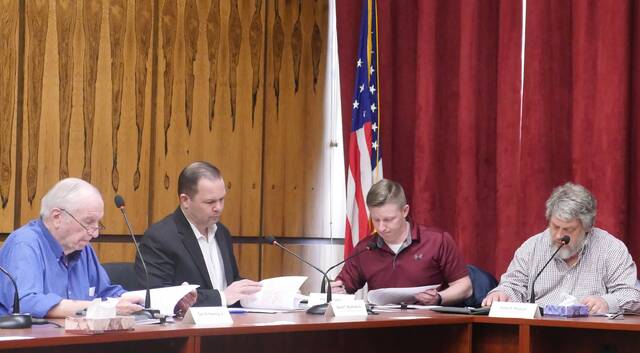
Luzerne County Planning Commission members review revisions of a data center zoning amendment Thursday that would cover 19 municipalities if it is eventually approved by County Council. Shown, from left, are: Carl Naessig, David Wychock, Patrick Coffey, and Peter P. Mikitish.
Jennifer Learn-Andes | Times Leader
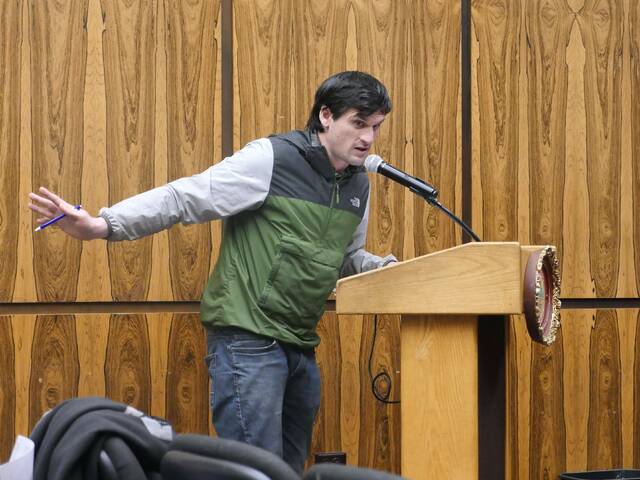
Butler Township resident Nate Eachus told Luzerne County’s Planning Commission Thursday the data center zoning amendment it is reviewing must ‘set the tone’ for others because it will cover 19 municipalities.
Jennifer Learn-Andes | Times Leader
After further considering more revisions on Thursday, Luzerne County’s Planning Commission held off on recommending a data center zoning amendment to County Council that would apply to 19 municipalities.
County GIS, Planning, and Zoning Director Dan Reese told the commission his office also wants more time to finalize suggested requirements for data center developer agreements, bonds, and building height.
The county zoning ordinance amendment covers an exhaustive set of conditions that must be met and mandates more extensive special exception approval from the county Zoning Hearing Board for all data center requests.
If approved by County Council, the amendment will take effect in the following municipalities that rely on county zoning instead of handling it on their own: the boroughs of Avoca, Courtdale, Dupont, Duryea, Hughestown, Jeddo, Laflin, New Columbus, Pringle, Warrior Run, West Wyoming, and Yatesville, and the townships of Conyngham, Fairmount, Hunlock, Huntington, Lake, Ross, and Union.
Newport Township is also on the list, but the municipality is in the process of switching to in-house zoning control.
No data center requests are pending in these municipalities, Reese said.
Thursday’s meeting was the second commission review of the evolving document drafted by Reese’s office, and a public information session was also held last week.
In response to public concerns about data center size and energy consumption, the latest amendment version redefines the three categories of allowable centers, according to the updated document posted on the planning section of luzernecounty.org.
The largest — “hyperscale” — was originally a single structure or campus of at least 500,000 square feet. New wording defines hyperscale centers at a minimum of 100,000 square feet with a maximum consumption of 200 megawatts at any point in time.
Centers and campuses in the next “major” category were first set at 100,000 to 499,999 square feet. The definition range was lowered from 20,000 to less than 100,000 square feet, with a 100-megawatt maximum consumption.
The final “edge” category initially was a single structure up to 99,999 square feet. It is now a single building or campus less than 20,000 square feet with a maximum consumption of 20 megawatts.
In the original plan, hyperscale and major data centers would only be considered in heavy industrial, light industrial, and mining zoning districts.
The proposal now says both may be in light industrial and also general and highway business districts if the development is on the same parcel as an existing power generation station.
There was no proposed revision to centers in the edge category, which can be in heavy and light industrial, mining, and general and highway business districts.
Setbacks were increased in the new version at the urging of citizens.
Originally, a 500-foot distance was proposed from the boundary of districts with residential structures or the lot line of a “sensitive receptor.”
The new proposed distance is 2,000 feet for hyperscale and major centers and 1,000 feet for edge ones.
In addition to residences, sensitive receptors include schools and childcare facilities, nursing homes, churches, community centers, and conservation and agricultural land. Animal hospitals, cemeteries, historic sites, and other types of properties and structures were added in the latest proposal.
Regarding noise, the initial draft limited data center sound to 67 decibels from 7 a.m. to 8 p.m. on weekdays and 57 decibels overnight and on weekends — a threshold some argued was too high.
The revision changes the time periods and caps: weekdays from 8 a.m. to 5 p.m., 55 decibels; and nights and weekends — with holidays added — 45 decibels.
For verification, a sound study “from all directions of the site” must be conducted by a third-party professional acoustical expert, the latest proposal says.
Sections were also revamped, addressing power and water supplies, emergency response plans, building aesthetics, the decommissioning of centers no longer in use, and other requirements.
Reese said he is attempting to resolve all lingering data center amendment matters at the commission’s next meeting on April 9.
State Rep. Jamie Walsh, R-Ross Township, thanked Reese and his staff for their thoroughness and for incorporating many of his recommendations, including new sections addressing pollinators.
Walsh said many are concerned about the loss of bees and the potential impact on crops they pollinate, noting a local farmer had contacted him about the seriousness of that issue.
Landscape buffers around data centers must now include pollinator habitat restoration to offset loss, the new amendment said. A study already had been in the amendment to verify vibration won’t be “perceptible to the human sense of feeling beyond the property line,” and that study also would have to “mitigate any negative impacts to wildlife and pollinator populations” caused by vibration, it said. Prospective data center developers also must create and manage a pollinator protection plan in compliance with state standards, it said.
Butler Township resident Nate Eachus cited a series of environmental and health concerns related to data centers and said the county’s amendment must “set the tone” for others because it will cover 19 municipalities.
Other business
In other business on Thursday, Reese presented other proposed amendments for possible future recommendation to County Council that would address battery energy storage systems and buffer requirements for new industrial projects bordering residential zones.
Battery energy storage systems are standalone units that kick in when electrical grids need a boost. The U.S. Environmental Protection Agency said lithium battery fires at some installations “have raised legitimate safety concerns in many communities.”
Reese said he wants to address the subject because he learned a Hunlock Township property owner has been approached by a company interested in adding a battery energy storage system. The draft amendment would require a permit for any systems holding at least 600 kilovolts, he said.
Reach Jennifer Learn-Andes at 570-991-6388 or on Twitter @TLJenLearnAndes.