From left: Luzerne County Election Director Emily Cook, county Manager Romilda Crocamo, and former Pennsylvania House Speaker Keith McCall meet on Wednesday to discuss election concerns in Pennsylvania counties.
Jennifer Learn-Andes | Times Leader
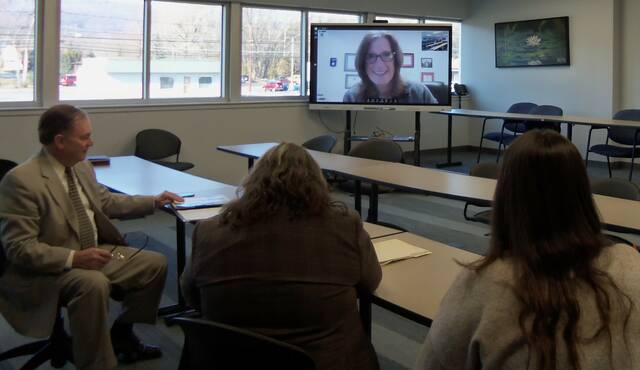
Former U.S. Rep. Melissa Hart remotely attended a Wednesday meeting with Luzerne County representatives as part of her bipartisan advocacy group’s efforts to collect data on election-related concerns across the state.
Jennifer Learn-Andes | Times Leader
A bipartisan advocacy group met with Luzerne County Election Director Emily Cook and County Manager Romilda Crocamo on Wednesday to hear election-related concerns that will be pitched to state legislators for suggested change.
The nonprofit group — the Democracy Defense Project — was established in Pennsylvania and seven other battleground states (Arizona, Georgia, Michigan, Nevada, New Hampshire, Ohio, and Wisconsin) before the 2024 election to promote election integrity, defend the democratic process, and work to “restore lost faith in our electoral system.”
Its Pennsylvania Board members met in-person and virtually with Cook and Crocamo at the county Operations Building in Wyoming, with the media invited to a post-meeting briefing. The Board members: former Pennsylvania House Speaker Keith McCall (D), former state Gov. Ed Rendell (D), and former U.S. Reps. Jim Gerlach (R) and Melissa Hart (R).
McCall said the visit here is the latest in a series of approximately 10 meetings held to date to obtain county election feedback across the state.
The issues Cook and Crocamo raised on Wednesday mirror those other counties want addressed, McCall said, citing the following:
• Allowing counties to perform the initial unsealing and processing of mail ballots, known as pre-canvassing, two or three days before Election Day instead of requiring them to wait until Election Day. This would ensure they are caught up, so the tallying of results is not delayed. Counties cannot start recording and reporting mail ballot results until after the polls close at 8 p.m.
• Moving back the deadline for voters to apply for mail ballots. It is currently a week before an election — a window, election officials argue, that is too short for voters to receive and return their ballots. Democracy Defense suggests an application deadline two weeks before an election, but McCall emphasized that is a decision for legislators.
• Updating the state voter database used by all 67 counties, known as the Statewide Uniform Registry of Electors, or SURE, system. This is already underway because the state had announced plans in March 2025 to implement a new streamlined elections management system that will eventually replace SURE and other current elections-related programs.
• Imposing a certification process or some other form of regulation for third-party entities that conduct mass voter registration drives. McCall said it’s common for these entities to drop off batches of hundreds of registrations that contain numerous applications from voters who do not exist, are not residents of the applicable county or have other flagged issues.
• Providing legislative clarity on curing, which is the process of providing advance notice of fatal mail ballot defects to voters so they can ensure their vote is counted. This county provides such notice, a practice the nonprofit supports, but some do not, McCall said.
• Enacting legislative authorization on mail ballot drop boxes.
“If we’re going to have drop boxes, it should be in the law one way or the other. It’s just not clear, and so voting from one county to the next is somewhat different,” Hart said.
Since the enactment of the 2019 bipartisan state legislation authorizing no-excuse-required mail ballot voting, multiple lawsuits have been filed, resulting in changing Supreme Court rulings regarding issues such as curing and ballot signatures and dates, Hart said.
“Yet the legislature has never gone back and fixed the law,” Hart said.
In addition to serving in the U.S. House of Representatives, Hart said she was a state Senator for a decade and recalls legislators reexamining and amending laws after Supreme Court rulings, so there was no confusion.
Hart said she is making the legislature the “responsible party” to respond to “these real practical concerns that all of these counties have been facing now for the last six elections.”
“It’s just not right. It is their responsibility to address them, and we’re trying to encourage them to do that,” she said.
The nonprofit also wants to further explore advocating for voter ID legislation, with McCall and Hart noting their group’s polling showed strong bipartisan support on the matter.
McCall said the state election law is “antiquated” and needs to be changed.
“We’re listening and are going to try to help advocate for that change,” he said.
In addition, Democracy Defense is aiming to dispel “misrepresentations that have been made about election fraud,” McCall said. The 2020 election in Pennsylvania was the “perfect storm” because it coincided with the implementation of mail ballot voting and the coronavirus pandemic, he said. Many election offices inundated with mail ballots took days after the election to tally them, causing changes in Election Day results, he said.
“There was a lot of confusion and a lot of mistrust in the elections, like there was all this massive fraud, when in fact there wasn’t,” McCall said, noting elections are run by local citizens and are “not rigged.”
Reach Jennifer Learn-Andes at 570-991-6388 or on Twitter @TLJenLearnAndes.