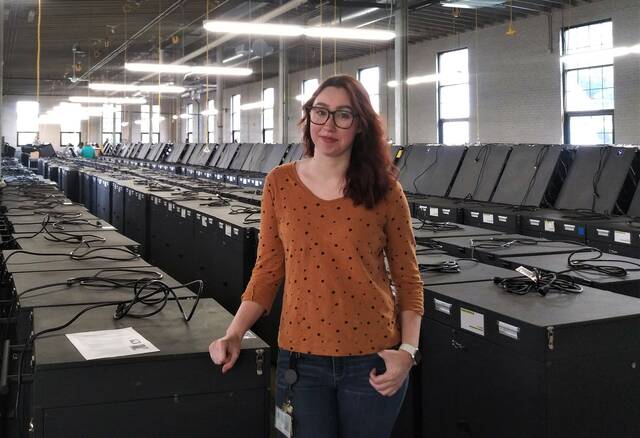
Luzerne County Election Director Emily Cook stands in the county’s voting machine warehouse in Wilkes-Barre during machine testing in September 2022, when Cook was election operations manager. Less voting equipment storage space will be needed due to a change in systems, prompting plans to move the central court to the building and add a central processing center.
File Photo
Luzerne County’s voting machine warehouse in Wilkes-Barre is set to house a new central processing center the county District Attorney’s Office has been planning for years.
Central Court will also move into the structure, officials said.
The plan was prompted by the county’s switch to a new voting system, which will reduce the footprint of equipment stored in the brick, county-owned warehouse near the county prison on Water Street, county Manager Romilda Crocamo said Monday.
“We don’t need all that space for elections, so we can repurpose it to use for all three,” Crocamo said, referring to central processing, central court, and voting equipment storage.
The county is considering alternative spaces to house voting equipment as a last resort, but Crocamo said there is a strong expectation that all three will fit in the Water Street structure, which contains two floors.
The new central processing center would create a single location to fingerprint and complete all necessary checks and paperwork required to book those arrested by police.
County District Attorney Sam Sanguedolce said the plan will free up law enforcement by reducing the time spent on processing tasks.
“We will attempt to staff the center at all hours, so if anyone is arrested, police can bring them here to be processed, allowing police to immediately return to patrol,” Sanguedolce said.
The center would have a grant-funded automated fingerprint identification system that provides a more current account of an offender’s criminal history than ink fingerprinting, Sanguedolce said. The resulting digital fingerprint scans are immediately sent to the FBI database along with a photograph, he said.
Convenient access to technology for municipal law enforcement will boost this county’s percentage of suspects fingerprinted, which is currently among the lowest in the state, Sanguedolce said.
“We have to address that, and this will be a great step in the right direction,” he said.
Fingerprinting ensures crimes are comprehensively linked to offenders and provides necessary documentation to increase the grading level when someone commits more than one offense, such as a retail theft, Sanguedolce said.
It also verifies the identity of an offender, he said, pointing out criminals often claim to be someone else, such as a relative.
Housing the central court in the same building as the central processing will also allow fingerprinting to be addressed on the spot if a magisterial district judge learns fingerprints were not obtained, he said.
Court officials established the central court in October 2017 as a hub to adjudicate magisterial-level criminal cases, allowing for streamlined scheduling and immediate access to all parties involved in the criminal justice system, officials have said.
The central court is located in a converted residential structure adjacent to the prison, and Crocamo said the building is “too small” for its intended purpose.
Crocamo said she supports the building reorganization plan because it is more efficient and better for police and the criminal justice system. Grants may be available to assist with building modification costs that have not been budgeted, she said.
An engineering review is underway, she said.
The warehouse once housed the Reichard and Weaver Brewery bottling house, according to the sign atop the building.
County officials opted to renovate the building in 2006, when the old lever machines were removed to make way for the first electronic machines, according to past reports. New windows, security enhancements, and other upgrades were completed in recent years.
Regarding the new voting system, voters will fill out their choices on paper ballots and then feed them into Hart InterCivic scanners for tallying. Previously, voters made selections on computerized touchscreen ballot marking devices that generated a printout for voters to review and scan for tallying.
With the change, the county will only need one electronic ballot marking device at each of the 186 voting precincts to accommodate those with disabilities, compared to the inventory of more than 700 ballot marking devices. Additionally, approximately 186 Hart InterCivic scanners/tabulators will be leased and stored.
According to the county’s latest monthly division report, the county election bureau consulted with the county law office to develop a plan to discard equipment from Dominion Voting Systems that will no longer be used.
Crocamo said Monday the election equipment has been separated, and “what can be sold will be sold.” If the ballot marking devices and scanners/tabulators cannot be sold, they will be catalogued and destroyed in compliance with Pennsylvania Department of State and Federal Election Assistance Commission requirements, she said.
County Election Director Emily Cook said implementation plans are on schedule for the new leased Hart InterCivic system to be used in the May 19 primary election. She is awaiting a confirmation date for the arrival of the new equipment.
Reach Jennifer Learn-Andes at 570-991-6388 or on Twitter @TLJenLearnAndes.