


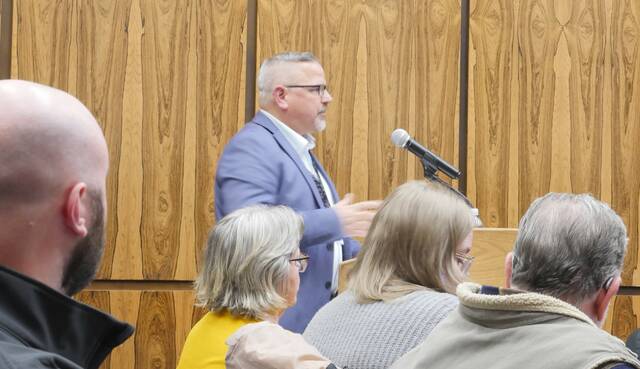
Luzerne County Correctional Services Division Head James Wilbur recently presented statistics on outside medical care for inmates to convey the magnitude of the situation to County Council.
Multiple prison correctional officers must transport and guard each inmate requiring medical treatment the entire time they are outside the prison, Wilbur said. Outside treatment is necessary when the required level of care cannot be provided by the prison’s medical unit, he said.
Through late November this year to date, inmates required more than 700 off-site medical visits and 125 emergency room visits, Wilbur said during his proposed 2026 budget presentation on Nov. 25.
Inmates also collectively spent more than 900 days in the hospital so far this year, he told council.
At one point, three inmates were on dialysis, each requiring three treatment sessions per week, Wilbur said.
“The acuity of the inmate medically is something like I’ve never experienced at this point,” he said.
Wilbur reiterated the trend largely stems from medical problems tied to inmate substance use disorder and the incarceration of more older inmates.
“Inmates today have a great deal of medical issues that often are ignored while they’re in the community,” he said, adding the county has an obligation to comply with “constitutional requirements to provide medical services to all inmates.”
The Pennsylvania Department of Corrections is also grappling with health needs associated with the “rapidly aging population” in the state prison system, according to 2025-26 budget testimony.
The county prison system houses inmates both serving sentences and awaiting adjudication. Inmates sentenced to two years or more are supposed to be lodged in state prison, officials have said.
Wilbur told council he was highlighting the outside medical treatment demands because it is a “major driving factor in overtime expenses.”
Overtime
As in past budget presentations, council members zeroed in on prison overtime.
The proposed 2026 budget seeks $1.56 million for overtime at the county prison on Water Street in Wilkes-Barre.
A total $1.2 million was budgeted for prison overtime in 2025, and $2.02 million was spent through the end of October — an $820,444 overrun, according to the latest monthly budget/finance report.
This year’s prison overtime allocation was a reduction from 2024, when the county budgeted $1.8 million and ended the year with actual spending just over $3 million, reports show.
Councilwoman LeeAnn McDermott asked Wilbur how he is covering the excess overtime expense.
Wilbur said savings from unfilled positions typically closes the gap — an option that is “not great.” As a result, he said he sought an increased allocation in 2026.
Policy changes have helped better control overtime expenses without compromising safety this year, he said. However, Wilbur said he must ensure the facility has minimum manning at all times every day, in addition to meeting outside inmate medical demands.
Council Chairman John Lombardo said the goal must be to fill all budgeted positions, which should theoretically reduce overtime.
Wilbur said there are currently 14 vacant correctional officer positions, and he has received ample applications to schedule training in January. He does not want any vacancies but cautioned a cycle of turnover is inevitable as senior officers retire and newer ones accept state positions or determine the job is “just not for them.”
Councilman Harry Haas said overtime has long been a “killer in this budget” and questioned if the requested $1.56 million is “realistic.” Haas asked Wilbur if the allocation should be raised to $2 million next year.
Wilbur said he cannot say for sure because he has no control over the “unpredictable” demands for outside medical treatment.
Top expense
The county prison system, which houses an average 550 inmates, remains the top departmental expense in the proposed 2026 budget, as it has been for many years. Total spending is budgeted at a proposed $33 million next year, which is a $1.5 million increase from this year’s budget. The budget covers costs at both the prison and nearby minimal offenders building on Reichard Street in Wilkes-Barre.
Wilbur praised the approximately 300 county corrections professionals who “work tirelessly to make sure that the mission is accomplished daily.” These workers “put their lives on the line” to ensure the care, custody, and control of inmates, he said.
Crediting the efforts of staff, Wilbur told council the county prison system recently obtained a letter of full compliance from the state corrections department, which means another inspection won’t be required until 2027.